A funded trading account is an account a proprietary trading firm gives you after you prove your strategy in an evaluation. You trade it under the firm’s rules, and when you make a profit, you can request a share of it as a payout, without putting your own savings at risk on each trade.
That’s the short version. The details matter, though, because “funded” means different things at different firms, and the rules you trade under decide whether you ever get paid. This guide explains how funded accounts work, what sim-to-fund means, the rules to look for, and how options traders can get one.
For how Vanquish handles each stage, our Vanquish Trader rules cover every plan side by side.
What is a funded trader?
A funded trader is someone who has passed a prop firm’s evaluation and now trades a funded account. Instead of building a large personal account first, they pay a fee to take an evaluation, show they can hit a profit target without breaking the risk rules, and then trade the firm’s account for payouts.
The appeal is simple. A trader with a solid strategy but a small account can trade a $50,000 or $150,000 account and keep a share of the profits, while their own money at risk is limited to the evaluation fee.
How do funded trading accounts work?
Most funded account programs follow the same three steps.
- You pay for an evaluation. Some firms charge a one-time fee per attempt; others, including Vanquish, charge a monthly subscription. The evaluation is sometimes called a challenge or a trading combine.
- You pass the evaluation. You need to reach a profit target while staying inside the firm’s risk rules, usually a maximum drawdown and sometimes a consistency rule or a minimum number of trades or days. Our guide to what an eval is covers this stage in detail.
- You trade the funded account and request payouts. There’s usually no profit target at this stage. You keep trading under the risk rules and withdraw your share of the profit when you meet the payout requirements.
If you break a risk rule at either stage, the account ends. Most firms let you reset or start again for a fee.
What is sim-to-fund trading?
Sim-to-fund is the model most prop firms now use, Vanquish included. Your evaluation runs on a simulated account using live market data, so prices, fills and volatility behave as they would in the real market, but no real orders are sent.
On most sim-to-fund programs, the funded stage is simulated too. What makes it “funded” is that your results now earn real payouts. Those payouts are performance-based rewards for trading within the program’s rules, rather than proceeds from trades placed with real capital. It’s worth knowing this before you choose a firm, because it shapes what “funded” actually means.
How payouts work
Once you’re funded, the firm sets out when and how you can withdraw:
- Profit split. The share of profit you keep. Many firms pay 80% to 90%. Vanquish pays 100%.
- Minimum payout. The smallest amount you can withdraw. On Vanquish, it’s $250.
- Frequency. How often you can request one, from daily to monthly depending on the firm and plan.
- Conditions. Some firms apply a consistency rule or a minimum number of trading days to each payout.
A payout also reduces your account balance, which matters if your loss limit doesn’t move when you withdraw. On Vanquish, it doesn’t, which is why the payout rules recommend leaving room above your limit.
Types of funded account programs
- One-step evaluations. You pass a single phase and move straight to a funded account. Vanquish uses this model.
- Two-step evaluations. You pass a challenge, then a second verification phase, often with a lower profit target, before you’re funded.
- Instant funding. You skip the evaluation and start on a funded account straight away. These usually cost more and come with tighter rules, because the firm hasn’t seen you trade yet.
The rules that decide whether you get paid
Two funded account programs with the same account size can be very different to trade. These are the rules worth comparing before you sign up:
If you’re not sure how a drawdown limit moves, our guide to trailing drawdown walks through each type with examples. And if a firm doesn’t answer every row of this table clearly on its website, treat that as a warning sign.
We’ve written more on what a prop firm with no hidden rules looks like.
Funded accounts for options traders
Most funded account programs are built for futures or forex. Options traders have far fewer choices, and many don’t realize a funded options account is an option at all. Our roundup of prop firms for options trading covers the landscape.
Vanquish is built only for options. Every plan lets you buy calls and puts on any ticker, from single stocks like AMZN to index and ETF options like QQQ. The Advanced Options plan adds Level 4 strategies: spreads, iron condors, covered calls and selling to open. Options also have a useful property inside a funded account: when you buy a call or put, your maximum loss on that trade is the premium you paid, which makes sizing against a loss limit easier to plan.
Pros and cons of a funded trading account
Pros
- Trade a much larger account than you could fund yourself
- Your money at risk is limited to the evaluation fee, not trading losses
- Clear rules that build disciplined habits
- Keep a share of the profit (on Vanquish, all of it)
Cons
- You trade under rules you didn’t set, and breaking one ends the account
- Evaluation fees or subscriptions add up if you need several attempts
- Trading is usually simulated, so payouts are rewards for performance rather than returns on real capital
- Rules vary a lot between firms, so you have to read them carefully
How to get a funded trading account
- Choose a firm and plan that fit how you trade. On Vanquish, our guide to choosing a plan matches each plan to a trading style.
- Learn the rules before your first trade, especially how the drawdown moves and whether there’s a consistency rule.
- Pass the evaluation. Size every trade around the room above your loss limit, not your account balance. Our guide on how to pass a prop firm evaluation covers the approach step by step.
- Set up your payout account as soon as you pass, so identity checks don’t delay your first withdrawal.
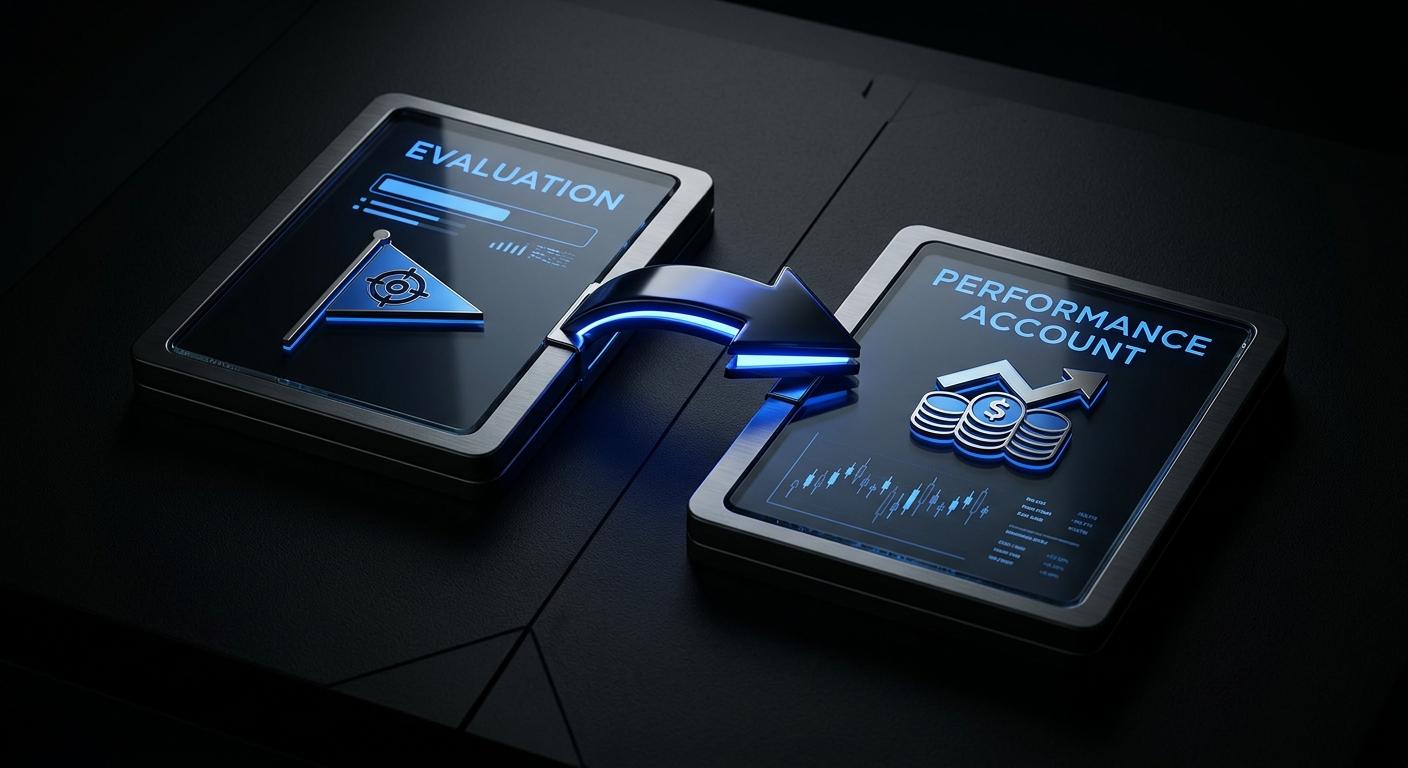
- Trade the funded account the same way you passed. Here’s what changes between the Evaluation and the Performance Account on Vanquish.
Funded trading account FAQ
What is a funded account in trading?
It’s an account a prop firm lets you trade after you pass its evaluation. You follow the firm’s risk rules and receive a share of the profit you make as payouts.
Is a funded account real money?
At most sim-to-fund prop firms, including Vanquish, trading takes place on simulated accounts using live market data. The payouts are real, but they’re performance-based rewards for trading within the rules, not proceeds from trades placed with real capital.
How much does a funded account cost?
It depends on the firm and account size. On Vanquish, plans are billed monthly, starting at $79 a month for a $10,000 Rapid Express account.
Can you lose money with a funded account?
You can lose the fee you paid for the evaluation or subscription, but you don’t cover the trading losses yourself. If you break a risk rule, the account ends and you’d need to reset or start again.
How long does it take to get funded?
It depends on the plan’s rules and how you trade. On Vanquish, there’s no time limit, and Rapid Express can be passed in a single day.
Can I get a funded account for options trading?
Yes. Vanquish offers funded accounts built only for options, from long calls and puts on any ticker to Level 4 strategies on the Advanced Options plan.
Ready to work toward a funded options account? Compare plans and account sizes on the plans page.